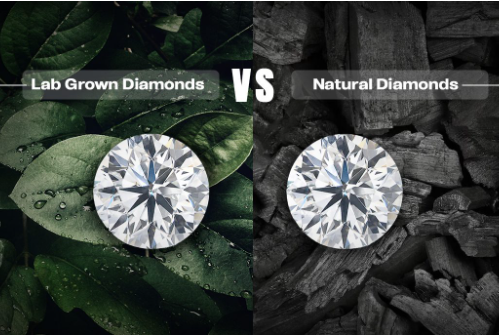
Diamonds have always been associated with love, engagement/wedding, and prestige. But with growing awareness about ethical and environmental issues, the conflict between the cultured diamonds and mined diamonds has come much into the fore. While consumers of yesterday were obsessed with achieving the right sparkle, today’s consumers are equally interested in the consequences of this sparkle. In this article, investigating the differences between the lab-grown and Natural diamond, concentrating only on the ethical perspective of them. If you’re wondering about the best place to buy rings that align with your values, we’ll also touch on that, including a closer look at why Rare Carat might be the perfect option for you. You can easily shop here and find the perfect ring without compromising on ethics or quality.
Understanding Lab-Grown Diamonds
Created diamonds, also referred to as cultivated or synthetic diamonds are grown in the laboratory and are chemically, mechanically, and optically identical to mined diamonds. These diamonds have the same composition as any regular diamond, chemically, physically and optically, but they are produced at a much higher rate, say in the order of few weeks.
The process of creating lab-grown diamonds involves two main methods: The more profound technologies are High Pressure High Temperature (HPHT) and Chemical Vapor Deposition (CVD). They both have a diamond produced from carbon atoms bonded to create a crystal that is fashioned into a diamond.
Ethical Considerations
Environmental Impact
This paper identifies three ethical issues related to natural diamonds, of which the first is environmental concern in the extraction of the mineral. Mining for diamonds is very demanding in that it uses water, large space, and energy in the form of fossil fuels. This has often been realized to favor deforestation, destruction of habitats, and even Soil erosion. However, with regards to environmental impact, cultured diamonds are without a doubt a much better solution. They use less space and water, and since they are grown under conditions, the probabilities of soil and water pollution are negligible.
Nonetheless it is crucial to state that even lab-grown diamonds are not devoid of negative influence on the environment. The production process requires large amounts of energy, most of which is got from sources that are not renewable. Hence the ethical decision between the artificial and the mined diamond depends on the practices that the producers undertake.
Human Rights and Labor Practices
Oppressive acts in diamond mining have throughout the past been linked to human rights abuses; especially in the conflicted regions. The term blood diamonds is used in a context where diamonds are mined in areas that are severely affected by conflict and violence and are used to finance conflict against the government. Unfortunately, even with the affirmative action’s such as the Kimberley Process to control the flow and sale of diamonds which are funding conflicts, it is almost impossible to determine whether the natural diamonds sold in the market are truly from the conflict-free sources.
Lab grown diamonds are a much more ethically correct option in this regard. There is no compromise of supporting conflict or contributing towards any violations of human rights since they are manufactured in research facilities. Also, one can argue that working conditions in diamond labs are much safer and follow the less egregious path compared to mining make lab grown diamonds more ethical for those who are concerned with human suffering.
The Appeal of Natural Diamonds
Thus, for all the ethical benefits of synthetic diamonds, naturally-mined diamonds will remain popular among consumers. Some of these clients are attracted by the mystery of the diamond that was formed three and half billion years under the pressure. Authentic diamonds are appreciated as special and historical, every such stone carries a history behind it.
Also, there are others who are apprehensive that cultured diamonds may not fetch the same price after sometime. There is still much doubt about the value of lab-grown diamonds for the long term, as technologies are progressing and the cost of producing those declines, although there is a trend in markets now.
Making the Ethical Choice
It is therefore important to appreciate that the ethical issue between lab-grown and natural diamonds is not so straightforward. Generally speaking, environmental impact and human rights are better with lab grown diamonds. Nonetheless, if the scarcity and heritage linked to natural diamonds are supreme values, one can choose a responsibly mined and ethically sourced natural diamond.
Those wishing to buy ethical diamonds should therefore be careful to look for the right sellers. The choice of stores where you will find rings that you consider to be socially responsible will be influenced by environmental issues, human rights issues, and the importance or lack of the importance of rarity.
Rare Carat: A Trusted Source for Ethical Diamonds
But what has not been clearly defined is a retailer that would offer those products while practicing ethical sourcing and from that point of view, Rare Carat is an exception. Rare Carat is fully involved in the sale and distribution of both man-made synthetic diamonds as well as natural diamonds of assured ethical sourcing together with full price disclosure. It presents a variety of choices, thereby facilitating choices on the ground of ethical considerations by the consumers.
At Rare Carat, there is still a strict selection of natural diamonds, where all diamonds provided are free from conflict and sourced from the right suppliers. Further, they cultivate their diamonds artificially, and the process leverages the best technology to contain the subject’s impact on the environment. Those seeking to make purchases here in search of ethical rings will find Rare Carat has a great catalog, as well as the added advantage of consulting a team of specialists in gemstones.
Conclusion
It’s not about the beauty or the tradition of the diamond, it is about whether you seek to make the right moral decision. When it comes to buying diamonds, it’s up to the customer whether lab-grown is a better option than natural diamonds in terms of the environment and human rights, or whether the sparkle and tradition associated with natural diamonds is the way to go.
Lastly, it is advisable to patronize stores that are quite truthful in their handling of jewelry and methods used in producing both natural and artificial rings. Rare Carat represents these features – it gives the buyer confidence that not only the car is aesthetically appealing, but also was bought fairly. In the ever changing diamond trade, it has never been more vital to make the right informed and ethical decision.
